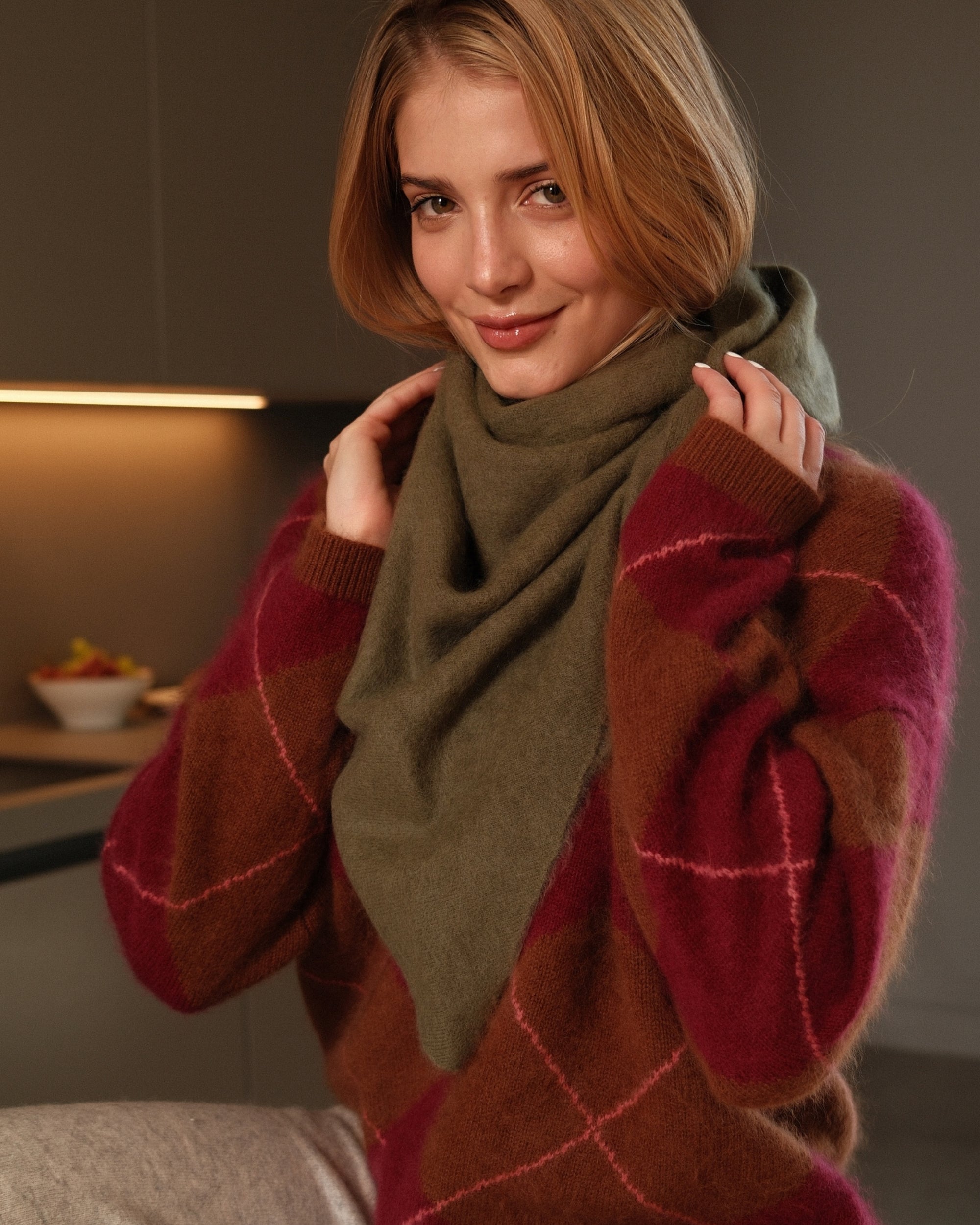
What does Grade-A mean? Cashmere quality explained
Grade-A is not a marketing term but a grading of the raw fiber — by length and fineness. Both are measured before the goat’s undercoat becomes a yarn. And both decide how a sweater looks after three winters.
How cashmere is graded
After combing, the undercoat is sorted: the finest and longest fibers are Grade-A, the middle ones Grade-B, the coarsest and shortest Grade-C. The lines run roughly at 14 to 16 microns for A, 16 to 19 for B, above that C. A micron is a thousandth of a millimeter — the difference is invisible to the eye and instant to the skin.
“100% cashmere” can be knitted from any of the three. The label doesn’t tell you which.
Fiber length
Long fibers can be twisted more tightly and don’t slip out of the yarn. That is exactly what decides whether a sweater still looks good after three winters or has gone baggy. Short fibers stay in the yarn only until friction works them loose — then they form bobbles, and the knit gets thinner with every wash.
Length only shows over time: a Grade-A piece pills at first and then stops. A piece made from short fiber never stops.
Fineness
Measured in microns: the finer, the softer on the skin. Grade-A typically sits at 14 to 16 microns — fine enough that nothing itches. From around 30 microns, fiber ends are stiff enough to irritate the skin; virgin wool is often above that, merino at 17 to 24. Cashmere sits so far below that the ends give way instead of prickling. Why that holds for sensitive skin too.
Where the finest fibers come from
Fineness is not chance but climate. The cashmere goat winters on the high plateaus of Central Asia at down to minus 30 degrees — the harder the winter, the finer and denser the undercoat it grows against it. In spring it is combed out, not shorn. One goat yields around 150 grams a year, only part of it Grade-A. More on where it comes from.
What Grade-A doesn’t guarantee
The best fiber is only the start. Then comes the yarn: single or two-ply. And the knit: dense or airy. A Grade-A yarn, thinly plied and loosely knitted, lasts no longer than a middling one. That is why we ply every quality twice and knit it fine and dense. How to check that is in How to recognize good cashmere.
And in merino-cashmere?
There too. The cashmere share in our 95/5 blend is the same fiber as in pure cashmere — Grade-A, because a short fiber slips out of a blend just as it slips out of a pure yarn. The merino brings the shape retention, the brushing the cloud-soft surface.
What that means for you
A Grade-A piece grows softer with wear instead of wearing out. It costs more to buy and less per day worn. After five winters it is the piece you still reach for — and the price has long since spread out to a few cents a day.
How you can tell
- Proof of origin: good cashmere is traceable, ours via a code on the yarn
- Handle: soft with substance, not soapy
- Pilling: eases off noticeably after the first few wears
- Shape: returns after stretching